Bobby King

Case study: Service design for government AI
I worked with data scientists and a delivery team to impelment AI across a public sector body.
The brief
The Department of Business and Trade (DBT) is a forward-looking government body. They have invested heavily in data and AI over the past ten years. Like other government organisations, they have to balance the risks of AI adoption with the opportunities.
By the time I joined in 2025 they had rolled out Microsoft Copilot on a trial basis along with an in-house tool. They were also developing bespoke tools using their in-house development teams.
DBT had an established AI department within the Digital directorate, consisting of an AI Lab and AI Factory. The AI Lab was set up to collect, triage and research ideas for new AI developments across the organisation but they had limited resources to prioritise them and give the best ones to delivery teams to build.
My brief was:
- define a service for the Lab
- improve their communications with other teams and directorate
- streamline their internal processes and their hand-offs to the Factory
What I did
Mapped the AI lab service and reviewed service outcomes
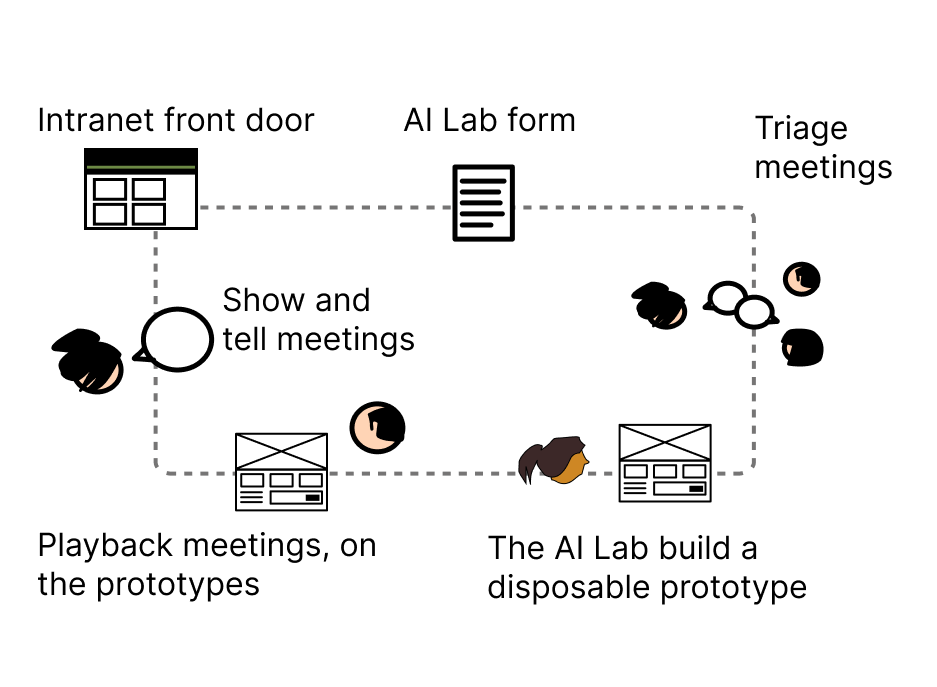
I created an 'inside out' service diagram for the AI lab. I based my approach on work done by a business analyst but created stages from a DBT staff member's point of view. I collaborated with experienced team members to create this, along with provisional pain points.
I noted any questions the team had along the way, as we can often answer these by running research. This exercise brought team members together to think about the service.
Created a 'good enough' plan for the future
Working with the service design lead, I drew up a provisional plan for the next quarter for the AI teams and reviewed it with the leads to check their understanding.
I drew on Kate Tarling's The Service Organisation to use brief statements and a provisional (imperfect) plan to focus their thinking.
Ran a hand-off workshop
The data engineers from the AI Lab would triage ideas and talk to the DBT teams themselves. They would only pick a small majority of ideas to turn into prototypes. If the DBT staff was happy with the prototype, they would hand off the idea to the Factory to build a permanent version.
I ran a kick-off with the data engineers to understand how they worked. They found triaging the ideas time-consuming. Another disadvantage for the system is that the person creating a prototype wouldn't be the person
I ran a workshop with both teams for them to think through the best way to make this work. This included their current challenges and what they'd learned from previous ideas which had gone through their pipeline.
To capture the workshop I wrote a Confluence page on Passing ideas to the factory to build: checklist and saved it in the Lab's team folder. This seemed like the best way of keeping the team's ideas alive, as a living document.
Experimented with continuous feedback mechanisms
For internal staff their 'front door' to the AI lab was the intranet. I worked with the performance analysis team to add surveys and to the intranet section to get continuous feedback.
We rewrote and reorganised their application form for new AI ideas based on staff feedback.
The Lab had a complicated triage process for deciding which AI ideas to take forward so I aligned this with the application form by giving them both the same five headings. They roughly went like this:
- Describe your idea
- Technology considered
- Senior sponsor (the Lab required a senior staff member to back new AI ideas)
- Risks
- Scale (just one team, the whole division, or cross-government)
The team also had a relatively complex scoring system. I worked with the leads to simplify it as most of the categories were either a pass or a fail - for example, without a Senior sponsor, the Lab wouldn't take an idea forward. I made the rules more explicit for people applying to the Lab.
I created a new intranet landing page to explain our process and used the same five headings.
The surveys we added turned out to have limited value as staff often ignored them. I issued follow-up emails to staff who had applied to the AI service. I then worked with a User Researcher to do more work with them to understand their pain points, goals and mental models.
Energised the team, at an away day
Office work can be slow and grinding. I worked with the Lead Service Designer, Keely Flint, and a designer to create a fun AI-themed installation on AI for our away day. We created a booth with a fake AI fortune-telling app on a laptop, as well as a TV running a looped video on AI predictions.
I worked with data scientists and a delivery team to impelment AI across a public sector body.
The brief
The Department of Business and Trade (DBT) is a forward-looking government body. They have invested heavily in data and AI over the past ten years. Like other government organisations, they have to balance the risks of AI adoption with the opportunities.
By the time I joined in 2025 they had rolled out Microsoft Copilot on a trial basis along with an in-house tool. They were also developing bespoke tools using their in-house development teams.
DBT had an established AI department within the Digital directorate, consisting of an AI Lab and AI Factory. The AI Lab was set up to collect, triage and research ideas for new AI developments across the organisation but they had limited resources to prioritise them and give the best ones to delivery teams to build.
My brief was:
- define a service for the Lab
- improve their communications with other teams and directorate
- streamline their internal processes and their hand-offs to the Factory
What I did
Mapped the AI lab service and reviewed service outcomes
I created an 'inside out' service diagram for the AI lab. I based my approach on work done by a business analyst but created stages from a DBT staff member's point of view. I collaborated with experienced team members to create this, along with provisional pain points.
I noted any questions the team had along the way, as we can often answer these by running research. This exercise brought team members together to think about the service.
Created a 'good enough' plan for the future
Working with the service design lead, I drew up a provisional plan for the next quarter for the AI teams and reviewed it with the leads to check their understanding.
I drew on Kate Tarling's The Service Organisation to use brief statements and a provisional (imperfect) plan to focus their thinking.
Ran a hand-off workshop
The data engineers from the AI Lab would triage ideas and talk to the DBT teams themselves. They would only pick a small majority of ideas to turn into prototypes. If the DBT staff was happy with the prototype, they would hand off the idea to the Factory to build a permanent version.
I ran a kick-off with the data engineers to understand how they worked. They found triaging the ideas time-consuming. Another disadvantage for the system is that the person creating a prototype wouldn't be the person
I ran a workshop with both teams for them to think through the best way to make this work. This included their current challenges and what they'd learned from previous ideas which had gone through their pipeline.
To capture the workshop I wrote a Confluence page on Passing ideas to the factory to build: checklist and saved it in the Lab's team folder. This seemed like the best way of keeping the team's ideas alive, as a living document.
Experimented with continuous feedback mechanisms
For internal staff their 'front door' to the AI lab was the intranet. I worked with the performance analysis team to add surveys and to the intranet section to get continuous feedback.
We rewrote and reorganised their application form for new AI ideas based on staff feedback.
The Lab had a complicated triage process for deciding which AI ideas to take forward so I aligned this with the application form by giving them both the same five headings. They roughly went like this:
- Describe your idea
- Technology considered
- Senior sponsor (the Lab required a senior staff member to back new AI ideas)
- Risks
- Scale (just one team, the whole division, or cross-government)
The team also had a relatively complex scoring system. I worked with the leads to simplify it as most of the categories were either a pass or a fail - for example, without a Senior sponsor, the Lab wouldn't take an idea forward. I made the rules more explicit for people applying to the Lab.
xxxI created a new intranet landing page to explain our process and used the same five headings.
The surveys we added turned out to have limited value as staff often ignored them. I issued follow-up emails to staff who had applied to the AI service. I then worked with a User Researcher to do more work with them to understand their pain points, goals and mental models.
Energised the team, at an away day
Office work can be slow and grinding. I worked with the Lead Service Designer, Keely Flint, and a designer to create a fun AI-themed installation on AI for our away day. We created a booth with a fake AI fortune-telling app on a laptop, as well as a TV running a looped video on AI predictions.
At lunchtime staff came up to try out the fake app as well as write ideas about AI predictions on a whiteboard. We deliberately went for something fun and provocative to get people thinking about how AI could impact DBT.
The outcome
I left the AI Lab with service outcomes they could work towards in future and a way of continually improving their service using research.
Next case study: Designing an AI-powered data platform
At lunchtime staff came up to try out the fake app as well as write ideas about AI predictions on a whiteboard. We deliberately went for something fun and provocative to get people thinking about how AI could impact DBT.
The outcome
I left the AI Lab with service outcomes they could work towards in future and a way of continually improving their service using research.